A missing tooth can affect your smile, chewing ability, speech, and overall dental function. Fortunately, modern restorative dentistry offers several options for replacing missing teeth, with dental bridges and dental implants being two commonly considered treatments.
But which option is right for you?
The answer depends on several factors, including the number of missing teeth, condition of neighboring teeth, gum health, jawbone condition, overall oral health, treatment goals, and budget.
Dr. Swapna’s Advanced Dental Clinic, led by Dr. Swapna Khandale, is located in Gadital, Hadapsar, Pune, Maharashtra, providing advanced and patient-focused dental care. Patients can discuss their tooth-replacement options and receive treatment recommendations based on their individual dental needs.

What Is a Dental Bridge?
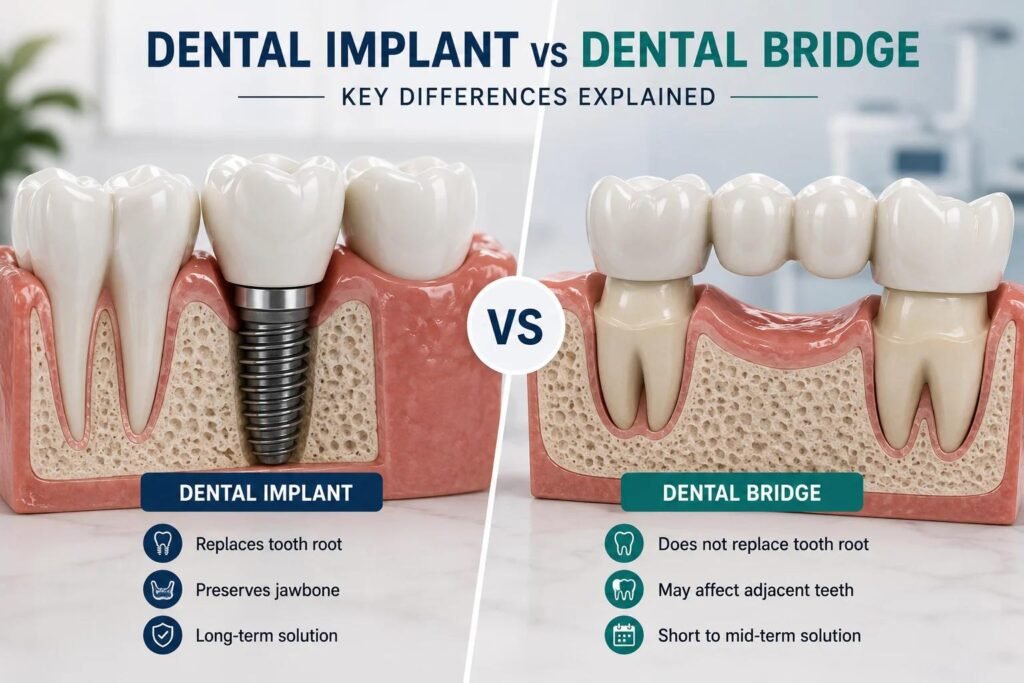
A dental bridge is a fixed restoration used to replace one or more missing teeth. The artificial replacement tooth, called a pontic, is supported by neighboring natural teeth or dental implants, depending on the type of bridge.
A traditional dental bridge usually involves placing crowns on supporting teeth adjacent to the missing tooth.
Benefits of Dental Bridges
A dental bridge may:
- Replace a missing tooth
- Restore chewing function
- Improve smile appearance
- Support speech
- Provide a fixed tooth-replacement option
- Help prevent neighboring teeth from shifting into the gap
The condition and strength of the supporting teeth are important when considering a traditional bridge.
What Is a Dental Implant?
A dental implant is a small implant fixture that is surgically placed into the jawbone to replace the root portion of a missing tooth.
After appropriate healing and treatment planning, an artificial tooth such as a crown can be attached to the implant.
For patients missing multiple adjacent teeth, dental implants can also be used to support an implant-supported bridge.
Benefits of Dental Implants
Depending on the patient’s dental condition, implants may:
- Replace a missing tooth without using neighboring teeth as bridge supports
- Provide stable support for a dental crown
- Help restore chewing function
- Provide a fixed tooth-replacement option
- Support implant-retained restorations
Implant treatment requires careful evaluation of the jawbone, gums, oral health, and other individual factors.
Dental Bridge vs Dental Implant: Key Differences
| Feature | Dental Bridge | Dental Implant |
|---|---|---|
| Main support | Natural teeth or implants | Jawbone |
| Replaces tooth root | No | Yes, with implant fixture |
| Surgery | Usually not required for traditional bridge | Implant placement requires surgery |
| Treatment time | Often shorter | Usually involves multiple stages |
| Neighboring teeth | May require preparation | Usually does not require neighboring teeth to support the implant |
| Bone assessment | Less central for traditional bridge | Important |
| Maintenance | Requires cleaning around bridge | Requires careful implant and gum maintenance |
| Suitable for | Selected missing-tooth cases | Selected patients with suitable conditions |
Neither treatment is automatically better for every patient. The appropriate choice depends on your specific dental situation.
Dental Bridge vs Implant: Which Looks More Natural?
Both dental bridges and implants can be designed to provide an aesthetically pleasing appearance.
The final appearance depends on factors such as:
- Tooth position
- Restoration material
- Shade matching
- Gum condition
- Tooth shape
- Dental laboratory work
- Overall smile design
A dentist can evaluate your smile and dental condition before recommending the appropriate restoration.
Which Option Is Better for Chewing?
Both treatments can restore chewing function when properly planned and placed.
A dental bridge uses neighboring teeth or implants for support, while an implant-supported tooth is anchored through an implant in the jawbone.
Your dentist will consider your bite and chewing forces when deciding which option is appropriate.
Dental Bridge vs Implant: Treatment Time
Treatment time can differ significantly.
Dental Bridge
A traditional bridge may often be completed in fewer appointments because it does not require surgical implant placement.
The process may involve:
- Dental examination
- Preparation of supporting teeth
- Dental impression or digital scan
- Temporary restoration if required
- Fabrication of the permanent bridge
- Final placement
Dental Implant
Implant treatment generally involves multiple stages:
- Dental examination and treatment planning
- Imaging and bone assessment
- Implant placement
- Healing and integration period
- Placement of the restoration
The overall timeline varies from patient to patient.
Dental Bridge vs Implant Cost in Pune
The cost of dental bridge and dental implant treatment in Pune varies depending on the patient’s individual requirements.
Factors Affecting Dental Bridge Cost
- Type of bridge
- Number of missing teeth
- Material selected
- Condition of supporting teeth
- Additional dental treatment
- Laboratory requirements
Factors Affecting Dental Implant Cost
- Number of implants required
- Implant system and components
- Type of crown or restoration
- Bone condition
- Need for additional procedures
- Overall treatment complexity
Because treatment requirements differ, an exact cost should be determined after a professional dental examination.
If you are comparing dental bridge vs dental implant cost in Hadapsar, a consultation can help you understand the expected treatment and associated costs.
Advantages of Choosing a Dental Bridge
A dental bridge may be considered when:
- You want a fixed replacement
- Neighboring teeth can adequately support the bridge
- You prefer a treatment that generally does not involve implant surgery
- A quicker restoration is clinically appropriate
- The dentist determines that a bridge is suitable
However, traditional bridges require consideration of the supporting teeth.
Advantages of Choosing a Dental Implant
A dental implant may be considered when:
- You want a fixed tooth replacement
- Neighboring teeth are healthy and you want to avoid using them as bridge supports
- Adequate bone and gum conditions are present
- You are suitable for implant surgery
- You are looking for a tooth-replacement option that includes replacement of the root portion
Implant suitability must be determined through a dental examination and appropriate diagnostic evaluation.
Who Is a Good Candidate for a Dental Bridge?
A dental bridge may be suitable for patients who have:
- One or more missing teeth
- Adequately strong supporting teeth
- Suitable gum health
- A bite that can support the restoration
- Good enough oral health for restorative treatment
Any active dental disease may need to be treated before bridge placement.
Who Is a Good Candidate for a Dental Implant?
Implant treatment may be considered for patients who have:
- One or more missing teeth
- Suitable jawbone conditions
- Healthy or appropriately managed gums
- Good overall oral health
- The ability to maintain proper oral hygiene
- No factors that would make implant surgery unsuitable
A dentist may recommend additional treatment if bone or gum conditions need improvement before implant placement.
How Long Do Dental Bridges and Implants Last?
The lifespan of either restoration varies.
Factors include:
- Oral hygiene
- Gum health
- Supporting tooth health
- Implant health
- Bite forces
- Restoration quality
- Regular dental check-ups
- Lifestyle and oral habits
Good daily oral hygiene and professional dental care can help maintain the health and function of your restoration.
How to Decide Between a Dental Bridge and Implant
There is no universal answer to “dental bridge or dental implant?”
Your dentist may evaluate:
- Number of missing teeth
- Location of the missing tooth
- Condition of neighboring teeth
- Gum health
- Jawbone condition
- Bite
- Overall oral health
- Treatment timeline
- Long-term treatment goals
- Budget and personal preferences
A detailed examination helps your dentist recommend the most appropriate option for your situation.
Dental Bridge or Implant Consultation in Hadapsar, Pune
If you have a missing tooth and are unsure whether a dental bridge or dental implant is right for you, a professional dental evaluation can help you understand your options.
Dr. Swapna’s Advanced Dental Clinic, led by Dr. Swapna Khandale, provides patient-focused dental care in Gadital, Hadapsar, Pune, Maharashtra.
During a consultation, your dental condition can be assessed and suitable tooth-replacement options can be discussed according to your oral health, functional requirements, and treatment goals. Choosing a Dental Bridge in Hadapsar, Pune is not simply about selecting the type that looks best or costs less. Your dentist needs to consider how the bridge will function with your natural bite and how well the supporting teeth and gums can maintain the restoration. Proper planning can help ensure that your Dental Bridge fits comfortably and supports your everyday oral function.
If you are searching for Dental Bridge treatment in Hadapsar, Dental Bridge treatment in Pune, or want to understand whether a Dental Bridge or dental implant is more suitable for your missing tooth, a personalized consultation can help you make an informed decision.
Schedule a consultation at Dr. Swapna’s Advanced Dental Clinic to discuss your Dental Bridge options, treatment process, expected cost, maintenance, and long-term oral care according to your individual dental condition.
Frequently Asked Questions
Is a dental implant better than a dental bridge?
Not necessarily. Both can be effective tooth-replacement options in suitable patients. The right choice depends on your teeth, gums, bone condition, bite, treatment goals, and overall oral health.
Which is cheaper, a dental bridge or implant?
The initial treatment cost varies based on the type of restoration and individual treatment requirements. A dental consultation is needed for an accurate estimate.
Does a dental implant require surgery?
Yes. Placement of a dental implant involves a surgical procedure to place the implant fixture into the jawbone.
Does a dental bridge damage nearby teeth?
Traditional bridges generally require preparation of the supporting teeth. Your dentist will assess whether the supporting teeth are suitable before recommending this treatment.
Can an implant replace multiple missing teeth?
Yes. Depending on the situation, multiple implants may support individual restorations or an implant-supported bridge.
Which treatment lasts longer?
The longevity of both bridges and implants depends on several factors, including oral hygiene, maintenance, bite forces, supporting structures, and overall oral health. Your dentist can discuss expected longevity for your specific treatment.