
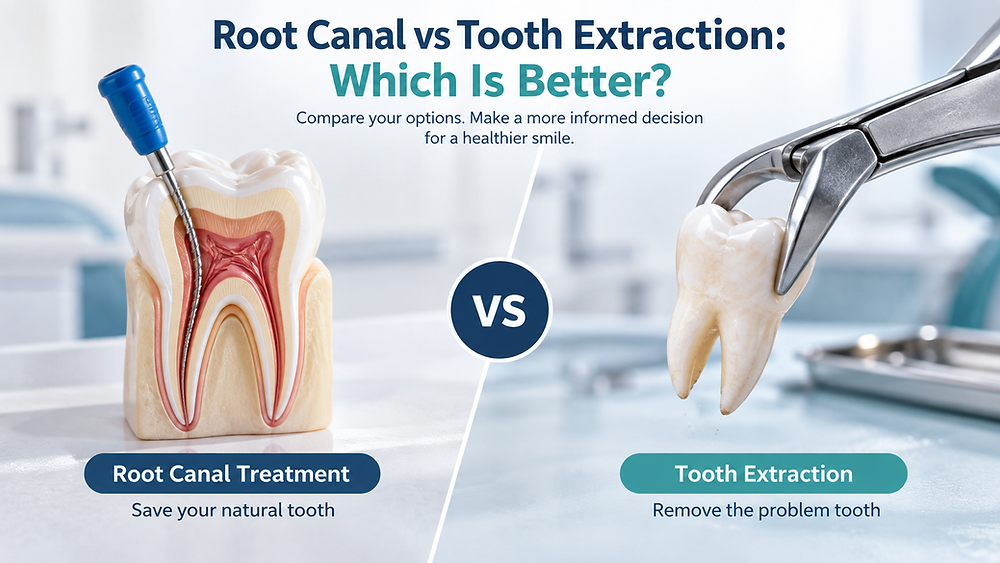
Root canal or tooth extraction? Learn when RCT can save a natural tooth and when extraction may be the better option for an infected tooth. When a tooth starts hurting badly, one thought can quickly come to mind: “Will I need a root canal, or will the tooth have to be removed?”
It is a common concern, especially when there is severe pain, deep decay, swelling or an infection.
Table of Contents
The good news is that extraction is not automatically the answer. In some cases, root canal treatment can help save the natural tooth. In other situations, the tooth may be too damaged to restore, making extraction the more suitable option.
The right choice depends on the condition of your individual tooth.
Root Canal vs Tooth Extraction: What Is the Difference?
A root canal treatment (RCT) is performed to treat a tooth when the pulp inside it becomes inflamed or infected. The damaged pulp is removed, the inside of the tooth is cleaned and disinfected, and the canals are sealed. The tooth can then be restored and continue to function.
Tooth extraction means removing the affected tooth completely.
At first, extraction may sound like the simpler solution. But removing a tooth creates a gap, and depending on the location of the tooth, you may later need to consider replacing it with an implant, bridge or denture.
That is why your dentist will usually look at whether the natural tooth can be predictably saved before recommending extraction.
When Is Root Canal Treatment Recommended?
An RCT may be considered when the pulp inside a tooth has become significantly inflamed or infected but the tooth still has enough healthy structure to be restored.
Some common situations include:
- Deep tooth decay
- Persistent or severe tooth pain
- Lingering sensitivity to hot or cold
- Pain while biting or chewing
- Infection around the tooth
- Dental trauma
- Certain types of cracks or damage
However, experiencing tooth pain alone does not mean you automatically need an RCT.
A dentist needs to examine the tooth and determine what is causing the problem.
Why Is Saving the Natural Tooth Important?
Your natural tooth has a role beyond simply helping you chew.
It works together with the surrounding teeth and supporting tissues. When a tooth can be successfully treated and restored, keeping it can help maintain normal function and avoid the immediate consequences of having a missing tooth.
This is one reason dentists may consider saving the natural tooth whenever the tooth has a reasonable chance of being restored successfully.
Root canal treatment can remove the infected or inflamed pulp while allowing the remaining tooth structure to stay in place.
When Is Tooth Extraction Necessary?
Sometimes a tooth has suffered too much damage to be saved predictably.
Your dentist may consider extraction when:
- The tooth is severely fractured
- There is not enough healthy tooth structure left
- Extensive decay has made restoration difficult
- The tooth cannot be properly restored
- Advanced problems around the supporting tissues affect its prognosis
- Previous treatment has failed and the tooth has a poor long-term outlook
In such situations, removing the tooth may be the safer option.
The important question is not “Which procedure is easier?”
It is:
“Which option gives this tooth the best possible long-term outcome?”
RCT vs Extraction: Which Is Better?
There is no universal answer.
If the tooth can be properly treated and restored, root canal treatment may allow you to keep your natural tooth.
If the tooth is too damaged or cannot be predictably restored, extraction may be recommended.
| Factor | Root Canal Treatment | Tooth Extraction |
|---|---|---|
| Natural tooth | Preserved | Removed |
| Main purpose | Treat internal infection/inflammation | Remove a tooth that cannot be predictably saved |
| Natural chewing function | Tooth can continue functioning after restoration | Missing tooth may affect function depending on location |
| Replacement | Usually not required simply because of RCT | Replacement may be considered |
| Long-term planning | Appropriate restoration may be required | Implant, bridge or denture may be considered |
So, RCT vs extraction should be decided based on diagnosis, tooth condition and restorability, not simply on which treatment seems quicker.
Is Extraction Always Cheaper Than Root Canal?
The initial cost of extraction can sometimes be lower than root canal treatment.
But it is important to think beyond the first procedure.
If you lose a tooth, you may eventually need to replace it. Depending on your situation, this could involve an implant, bridge or denture.
Root canal treatment also usually requires a final restoration, and some teeth may need additional protection such as a crown.
Therefore, ask your dentist about the complete treatment plan and long-term costs, rather than comparing only the price of RCT and extraction.
Is Root Canal Treatment Painful?
Fear of pain is one of the biggest reasons people delay root canal treatment.
Modern RCT is performed using local anaesthesia to keep the patient comfortable during the procedure.
Some soreness or sensitivity can occur after treatment, particularly when the tooth was already inflamed or infected.
If you are nervous about the procedure, tell your dentist. Understanding what will happen can make the experience much less stressful.
What Happens If an Infected Tooth Is Left Untreated?
An infected tooth should not be ignored simply because the pain becomes less intense.
Dental infections can progress and may cause swelling or an abscess. In some cases, the infection can affect the tissues surrounding the tooth.
Painkillers may temporarily reduce discomfort, but they do not remove the underlying source of a dental infection.
If you have persistent tooth pain, swelling or pain while chewing, getting the tooth examined is a better approach than repeatedly waiting for the symptoms to disappear.
Can a Dentist Save Every Infected Tooth?
No.
Whether an infected tooth can be saved depends on several factors.
Your dentist may evaluate:
- The amount of remaining healthy tooth structure
- The extent of infection
- The condition of the tooth roots
- Whether the tooth is cracked
- The supporting bone and gum condition
- Whether the tooth can be properly restored
After the examination, your dentist can explain whether RCT is realistic or whether extraction would provide a better outcome.
What Should You Ask Before Choosing Extraction?
If you have been advised to remove a tooth, it is reasonable to ask a few questions before making a decision:
“Can this tooth still be saved?”
You can also ask:
- Why can’t the tooth be restored?
- Would root canal treatment be possible?
- How much healthy tooth structure remains?
- What happens if I delay treatment?
- If I choose extraction, will I need to replace the tooth?
- What would the complete treatment involve?
- What is the expected long-term outcome?
Having this conversation can help you make a decision based on your actual dental condition rather than fear or assumptions.
What If the Tooth Is Causing Severe Pain?
When a tooth is causing severe pain, it can be difficult to think beyond getting immediate relief.
But pain is a symptom, not the diagnosis.
A dentist needs to identify whether the problem is deep decay, pulp inflammation, infection, a crack, gum disease or another condition.
Depending on the diagnosis, treatment could involve a filling, root canal, extraction or another procedure.
This is why you should not decide on extraction or RCT based only on the level of pain.
Tooth Treatment in Gadital, Hadapsar, Pune
If you are dealing with an infected or severely damaged tooth around Malwadi, Gadital, Hadapsar or nearby areas of Pune, a dental examination can help you understand whether the tooth can be saved.
Dr. Swapna Khandale provides dental care in the Gadital-Hadapsar area of Pune, Maharashtra. If you are experiencing persistent tooth pain, swelling, pain while chewing or symptoms of a tooth infection, getting the tooth examined can help you understand whether root canal treatment or extraction is appropriate.
Rather than choosing between RCT and extraction on your own, discuss the condition of your tooth and the long-term options with your dentist.
Final Thoughts
There is no simple rule that says root canal treatment is always better than extraction, or that extraction is always the easier choice.
If your natural tooth can be predictably treated and restored, RCT may give you the opportunity to keep it.
If the tooth is severely damaged and cannot be restored properly, extraction may be the more appropriate option.
The best treatment is the one that fits the condition of your tooth and your long-term oral health.
So, if you have been asking yourself, “Should I get an RCT or remove the tooth?”, start with a proper dental examination. Once the cause and condition of the tooth are clear, the decision becomes much easier to understand.
Frequently Asked Questions
1. Is root canal better than tooth extraction?
Not in every case. If the tooth can be predictably restored, RCT may help preserve the natural tooth. If it cannot be restored, extraction may be recommended.
2. Can an infected tooth be saved with a root canal?
Some infected teeth can be treated with RCT if enough healthy tooth structure remains and the tooth has a reasonable prognosis. A dentist must assess the individual tooth.
3. Is tooth extraction a permanent solution?
Extraction permanently removes the affected tooth, but the missing tooth may need replacement depending on its location and your dental needs.
4. What is the difference between RCT and extraction?
RCT treats the inside of the tooth while keeping the natural tooth in place. Extraction removes the entire tooth.
5. Should I extract a tooth because it hurts badly?
Not necessarily. Severe pain does not automatically mean the tooth must be removed. The cause of the pain and whether the tooth can be restored need to be assessed first.
6. How long can I wait before treating an infected tooth?
It is better not to deliberately delay treatment. An untreated dental infection can worsen, so persistent pain, swelling or other signs of infection should be evaluated promptly.

One Response